The world now speaks digital.
From smartwatches to healthcare systems, from education to agriculture, code has become invisible yet omnipresent.
However, in most schools, this universal language is still not taught from an early age.
Code: a new universal language
Code today is what writing was during the Renaissance: a means of understanding the world.
Learning to code means understanding how the tools we use every day “think.”
It’s not just a matter of technique, but of digital culture.
What coding really develops
Contrary to popular belief, coding doesn’t teach you to “talk to a machine,” but to think better.
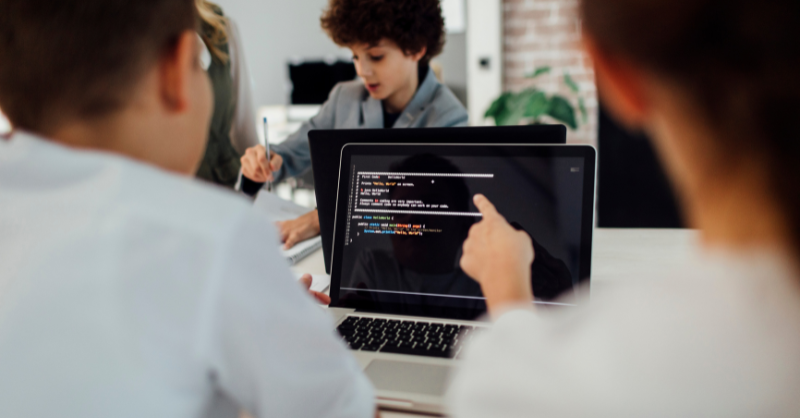
Students who are introduced to programming learn to:
-
Structure their logical thinking,
-
Accept mistakes as a step in learning,
-
Seek solutions rather than answers.
This mental exercise builds critical and creative minds — the key skills of the 21st century.
Koding Schools: learning through play
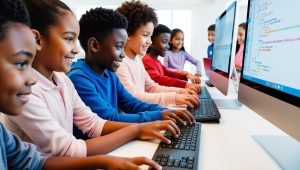
At Koding Schools, we have created a pathway that introduces computational thinking as early as primary school.
Through concrete projects (games, mini-apps, simplified AI), students understand how digital technology works while having fun.
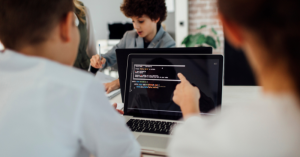
Example: a 9-year-old student learns to make a character move in Scratch.
Behind the game: concepts of variables, sequences, and conditions — in other words, the foundations of algorithmic thinking.
A universal skill, not an elitist one
In the future, understanding code will be as natural as knowing how to read or write.
It’s a skill of inclusion, not exclusion.
Because the more children understand the logic behind technologies, the more they can turn them into tools of expression — and not dependence.
Pedagogical benefits aligned with research
Studies show that technology enhances learning when it strengthens pedagogy (guided practice, feedback, differentiation), not the other way around. The recommendations from the Education Endowment Foundation (EEF) emphasize the importance of relying on specific uses that optimize teaching rather than stacking up digital gadgets. This is AIA’s philosophy: empowering professional teaching practices. (EEF)
Similarly, pedagogical differentiation — when properly supported — is associated with positive effects on student achievement, although its effectiveness depends on the level of support provided to teachers (training, resources, feedback). AIA provides this operational boost daily to move from intention to implementation. (ERIC)
Finally, AIA’s approach aligns with UNESCO’s guidelines: AI serving learning, ethical and human-centered, valuing the role of teachers and respecting governance frameworks. (UNESCO Documents)
Conclusion: preparing digital citizens
- Time: minutes saved through automatic summaries, ready-to-adapt activity suggestions, differentiated materials generated on demand.
- Clarity: a synthetic view of the lesson, with additional examples immediately available.
- Energy: less “out-of-class” cognitive load, more availability for human interaction.
- Creativity: an ideation partner that suggests varied approaches (projects, challenges, light gamification, collaboration).
…and what students gain
- Learning paths tailored to their level and pace.
- Engaging activities that make sense and diversify learning formats (individual, peer, group).
- More feedback and opportunities to develop critical thinking, creativity, and problem-solving.
AIA doesn’t replace the teacher. It enhances education.
At Koding Schools, we stand by a simple idea: AI does not replace human connection. On the contrary, it frees up time for what no one can automate:
- Creating connection and trust with students.
- Encouraging, inspiring, motivating.
- Developing critical thinking and creativity.
That’s what we call: education enhanced by artificial intelligence.
A clear ambition for Koding Schools
The launch of AIA is part of a global vision:
- Train the next generation in digital skills (coding, data, digital citizenship).
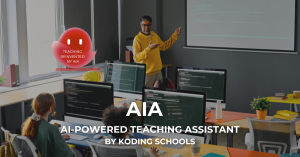
- Equip teachers with a unique contextual educational AI.
- Position Morocco as a major player in EdTech — starting in our local classrooms, then internationally.
Our ambition is clear: to make AIA the leader in artificial intelligence applied to education, serving both teachers and students.
In practice: how to start?
- Are you a teacher on Koding Schools? Activate AIA from your lesson space and test it in your next sequence.
- Do you manage a school? Contact us for a beta pilot: we’ll support your teams with training, setup, and impact monitoring.
- Curious? Request a demo: we’ll show you AIA in a real lesson preparation scenario.
Conclusion
AIA is not a trend: it’s an operational tool designed with and for teachers, right where pedagogy happens — the lesson. By making differentiation easier to prepare, providing contextualized content, and lightening invisible workload, AIA helps teachers refocus on what truly matters: time spent with students.
Education is changing. With AIA, it’s changing in the right direction: more human, more inclusive, more effective.
Sources and further reading
- OECD – TALIS 2018: time dedicated to preparation and non-teaching tasks, cross-country variations. (csicr.cz)
- UNESCO – Global Report on Teachers: teacher needs by 2030 and professional challenges. (UNESCO)
- UNESCO – AI and Education: Guidance for Policy-Makers: principles for ethical, human-centered educational AI. (UNESCO Documents)
- Education Endowment Foundation (EEF): recommendations on the use of digital technology, impact conditioned by pedagogy. (EEF)
- Research on differentiation: recent systematic reviews and meta-analyses. (ERIC)
Note: AIA is currently in beta. Its capabilities and access model (monthly free prompts indexed to the number of students) may evolve based on field feedback.